Spring “Break”

It’s not exactly half way through the Spring Semester, but last week was Spring Break.  It’s not how I remember it when I was younger, that’s for sure!  I took some time off work so I could work on assignments that are due next week: an economics problem set and a stakeholder analysis paper.  The problem set is done … the paper still needs a little work, but there’s some time left before it’s due on Tuesday.

This past Monday, registration for the Summer Semester opened.  We had been told in advance that classes fill quickly, and since there were only a handful of courses being offered, all seats were filled within minutes.  For quite a while before the registration window opened, I debated whether I should take a class this summer.  In the end, I decided against it for this year, but am leaving the window open for next summer.

On Tuesday, the class list for Fall Semester was released and we were asked to update our goals/research statements by May 19.  The confluence of these two events is actually fairly significant given the program requirements for the next couple of semesters.

  • First, we are updating our goals/research statements in anticipation of a faculty meeting on May 20.  On that date, all faculty will be meeting to discuss the doctoral students and our progress in the program.  It is important that we keep these statements updated.
  • Second, we are required to choose a chair for our Field Committee by the end of the third semester (which will be Fall 2011).  Because the chair for the Field Committee usually becomes the chair for a doctoral student’s Dissertation Committee, this is an important decision.
  • Third, now that almost all core courses are out of the way (PUBP 800 is the final core course, and will be taken in the Fall), choice of course becomes more important.  Rather than deciding which core courses we’ll be taking, we will now choose courses based on our fields within public policy.

And finally … on a related note, the Comprehensive Qualifying Exam for most of us will be January 5-9, 2012.  This exam tests knowledge of the information covered in the program’s core courses (PUBP 800, 801, 804, 805).  The “comp” is one of two major exams before the dissertation (the other is the Field Exam).

So yes, it was Spring Break this week … I think! 🙂
Teaching Methods Workshop

On Friday, I participated in the first part of a two-part series on teaching methods.  While it is not a required part of the PhD curriculum, I found it really worthwhile.  The session lasted almost the full two hours it was scheduled and there was a high level of interaction between the two who team-taught and the students who attended.  We covered a lot more material than I expected and in areas I wouldn’t have considered otherwise.  Topics such as how to create a lesson plan, strategies for ensuring understanding of the material, and how to keep students interested were covered.  While I don’t teach professionally now, I gained a lot of insight into what is needed to be effective.  I’m really looking forward to the next session on March 25!

Spring Registration

About a week and a half ago, we registered for Spring classes and I have to say it was quite an experience! We (the PhD students) had been told that we should register as soon as the window opened in order to get into the classes we wanted; especially since one of the courses most of us needed is also a mandatory course for Masters students.

I arrived on campus in plenty of time to “get comfortable” and log in ahead of the 3:00 PM window opening. I checked a couple of times before the appointed time with no luck. 3:00 definitely means 3:00. At exactly 3:00 PM, I was able to log in to the registration website. Fortunately, I had written down the numeric codes for the four courses I’ll be taking next semester. I typed them in and clicked send. The screen froze.

I had no idea what to do. Thoughts ran through my mind that the hype was only that – hype. But then the Masters student who was sitting at the table next to mine trying to register using his laptop sprung up and bolted toward the computer room in a panic. Maybe the hype was real …

I waited for 30 seconds and my screen was still not responding. I checked other sites in another window – they worked. Clearly this was a traffic issue on the registration site. In a moment of frustration, I closed the window I was using for registration and tried to log in again. After what seemed like forever (in reality, a matter of 2-3 minutes) I was back in. I reentered the codes and clicked send. This time, I got past the initial screen, but received a notice saying that my registration had already been updated.

When I checked my schedule, it turns out that my registration had made it in on my first attempt; I just didn’t receive confirmation. At 3:10 PM, out of morbid curiosity, I checked availability of the dual-tracked course. There were three sections available. Sure enough, two of the three were already full and the third had only a couple of seats available. Wow! I’ve never experienced anything like that!

So what courses am I taking next term?

PUBP 720 – Managerial Economics
PUBP 804 – Multivariate Statistical Analysis
PUBP 805 – Public Policy Systems and Theory
PUBP 850 – Seminar in Public Policy

More to come as this term winds to a close …

PhD Student/Faculty Retreat

Yesterday was the first official meeting of my post-graduate academic career.  It was an all-day affair at the Country Club of Fairfax and could be otherwise described as “orientation”.  It was definitely good to be able to put a face to names I had only read about before (more about that later).

Before describing the day’s events, let me say that the food they served was very good and there was lots of it.  They fed us breakfast, lunch, and dinner … with snacks between and an open bar at 6:00 PM.  This would lead one to believe that it be hard to leave the retreat without feeling extremely full.  Hard, yes, but not impossible.  There was so much conversation during the meals that while the food was plentiful and very good, it wasn’t where we focused most of our efforts.

Upon arrival and registration, we were each issued a stack of papers which included, among other things, an agenda of the day’s events and a bound copy of the 2010-2011 handbook (which governs our time in the program).  Then it was time to pose for individual photos before breakfast.

Part I:
The first part of the day was introductions.  There are 21 incoming PhD students and there were at least that many faculty at the retreat.  Hearing all the areas of research that the faculty are involved in was a bit overwhelming.  It really does cover the spectrum of interest.  We had a couple of breaks and I was able to speak with many of the faculty including my advisor and the author of a book I’m reading for one of my courses.  Back to my “more about that later” reference, I experienced my very own “celebrity sighting” yesterday.  Bill Schneider is on faculty now with the School of Public Policy.  I remember watching him regularly on CNN … and now he’s on faculty in the school where I’m studying.  Very cool!

Part II:
The second part of the day consisted of a panel discussion on policy research and a presentation on ethical issues in policy research followed by a group photo.

Part III:
GMU’s School of Public Policy has a new dean this year – Dr. Edward Rhodes.  The students and faculty were divided at the beginning of the third part of the day.  Dr. Rhodes spoke to the faculty while Dr. Pfiffner (Director of the PhD Program) and Beth Eck (Assistant Dean for Program Management) spoke to the students about the curriculum and student services.  Then a panel of current students spoke to the incoming PhD students about how to succeed in the program.

What did I learn during the retreat?  Quite a bit, actually.  There were a lot of administrative issues that were explained to us and it was good to have as many questions answered as there was time to answer.  One of the most valuable takeaways of the retreat, however, was not to choose a dissertation topic too early.  Many of the incoming PhD students (myself included) have expressed strong interest in particular topics that could become dissertations.  We received the recommendation that we should explore many different possible areas for research before focusing on one – preferably at the end of our first year.  So that’s what I’m going to do; I will keep my initial interests in mind, but I will also consider (not rule out?) other possibilities for my research.

I left the retreat a bit overwhelmed by the breadth of what we had covered, but also quite motivated.  I’m really looking forward to getting started next week!

Academic Advisor

Last week I received my academic advisor assignment for the PhD program.  I think this is going to be a good fit.  My advisor is an Associate Professor of Public Policy and Enterprise Engineering.  He has expertise in the areas of electronic commerce and supply chain integration, international telecommunication, Enterprise Resource Planning (ERP) system implementation and design, and ERP-based Business Process Engineering methods.

Though it sounds a bit technical, this is all good stuff.  A lot of what I do in my job relates closely to my advisor’s areas of expertise.  Here is an excerpt from the Statement of Purpose I wrote to accompany my application to the PhD program:

I am applying for admission to the GMU PhD program in Public Policy because I am interested in gaining the skills and background necessary to conduct advanced research into Information Technology policy and its effect on organizations.  In these days of ever-tightening budgets, government agencies are being asked to do more with less.  Government leaders are constantly challenged to find newer, more creative ways to accomplish the mission of government.  When used properly, Information Technology is a powerful force multiplier.  How Information Technology is used within an organization depends greatly on organizational structure, policy, and processes.  I am committed to achieving a greater understanding of these focus areas and how to apply that understanding to maximize their interrelated strengths.

In my current capacity as a supervisory enterprise architect in the Federal Government, I am acutely aware of the impact Information Technology makes on an organization.  One of the challenges I face on a daily basis is how to align the organization’s enterprise architecture with policy and doctrine.

I believe that the GMU PhD program in Public Policy (with a concentration in Organizational and Information Technology) would be of great value in my efforts to achieve the understanding necessary to increased organizational effectiveness. It would provide me the ability to focus my analytical and management skills in analyzing government’s Information Technology challenges and would possibly open new areas for research.  Upon completing the PhD program, I would like to apply my newly acquired skills to discover new and innovative ways to affect organizational structure and policy within the government.

So I’m looking forward to working with my academic advisor – I think it’ll be a really good fit!

All Signed Up …

OK … I’m officially enrolled in my first semester courses.  I’m going to try my hand at both carrying a full academic load and working full time.  It won’t be the first time.  Back when I was a bit younger, I carried a full undergraduate load and worked 50 hours per week.  So how did that turn out?  It was challenging.  I wouldn’t recommend it if you can avoid it.  However, I’m not working 50 hours any more – I work a 40 hour week, and I’m not carrying a 15-hour academic load – I’ve enrolled for 10 hours.  Yes, there’s quite a difference between undergraduate and graduate work, but I’m willing to give it the “old college try”.

So here’s my first tranche of courses:

  • PUBP 704 – Statistical Methods in Policy Analysis
  • PUBP 730 – US National Policy System and Theory
  • PUBP 801 – Macro Policy

Step One …

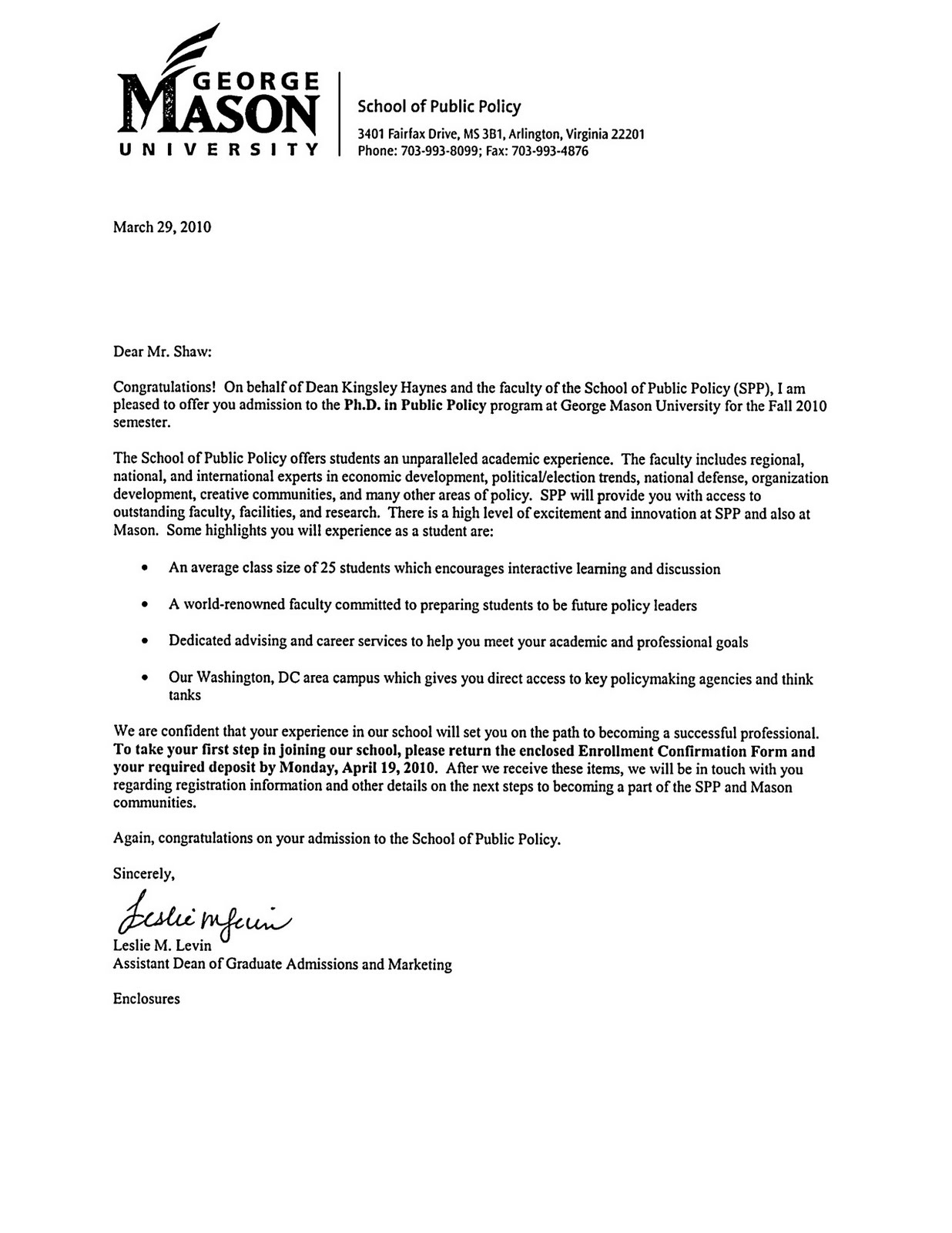
Well, here goes nothing!  Late last fall, I applied for the PhD in Public Policy at George Mason University and I recently found out that I was accepted.  So I’ve decided to track my progress through the (hopefully only) four year journey toward earning my PhD.  I start classes this fall, but I’ll be posting some updates between now and then to set the background for what I’m betting will turn out to be a very intense experience.  Come along for the ride!